
Writing a high-quality essay is a rite of passage for students in the United States. However, the transition to American academic standards—whether you are an international student or a domestic high schooler entering college—can be fraught with stylistic landmines. American English and its accompanying formatting styles (APA, MLA, and Chicago) have specific idiosyncrasies that, if ignored, can lead to lower grades or even accusations of academic dishonesty.
As a senior content writer with years of experience in the academic sphere, I’ve seen thousands of students struggle with the same recurring issues. This guide breaks down the most common mistakes in American essay formats and provides data-driven solutions to help you polish your prose.
1. The Trap of “Fluffy” Introductions and Weak Hooks
In American academia, brevity and clarity are king. Many students make the mistake of writing long, “flowery” introductions that fail to get to the point. According to a study on academic writing clarity, essays that state their thesis within the first 15% of the text consistently receive higher engagement scores from evaluators.
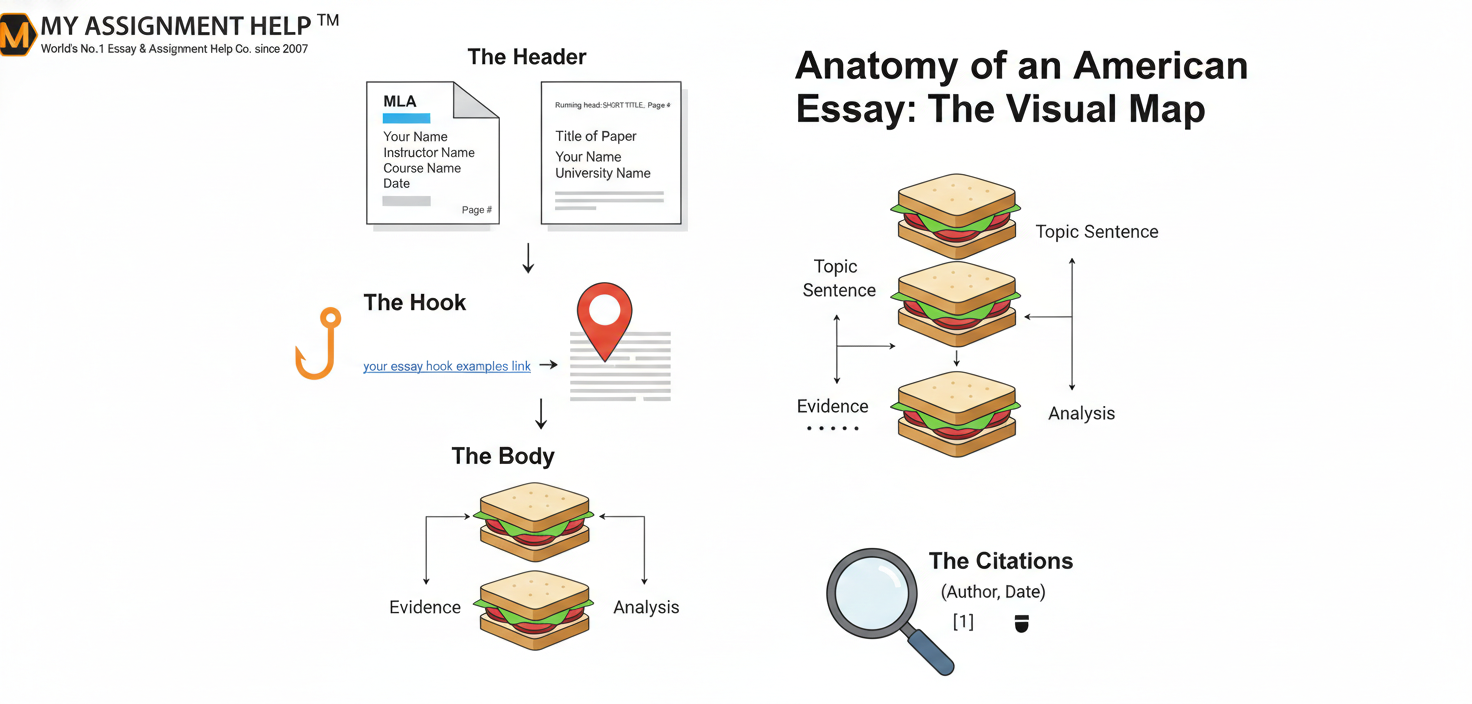
One of the most frequent errors is failing to grab the reader’s attention immediately. A weak start often leads to a weak argument. To master the art of the opening, you should study various essay hook examples to understand how to engage an audience using statistics, anecdotes, or provocative questions. Without a strong hook, your reader may lose interest before reaching your core argument.
2. Neglecting the “Thesis-First” Structure
Unlike some European or Asian writing styles that favor a “delayed-disclosure” approach—where the main point is revealed at the conclusion—the American essay is traditionally linear and deductive. In the U.S. education system, clarity is prioritized over mystery.
A common mistake is burying the thesis statement in the middle of a body paragraph. In American formats, the thesis must be the “North Star” of the paper, typically appearing at the end of the introductory paragraph. If you find yourself struggling to structure your argument or align it with U.S. standards, seeking professional essay help can provide the structural framework needed to ensure your paper meets the rigorous expectations of Ivy League and state university professors alike.
3. Style Manual Mix-ups: APA vs. MLA vs. Chicago
Perhaps the most technical area where students stumble is the strict adherence to style manuals. Each discipline in the US has a preferred format. According to a survey by the Journal of Writing Analytics, nearly 40% of point deductions in freshman English papers are attributed to formatting and citation errors rather than the content itself.
To avoid these deductions, use the comparison table below to identify the requirements for your specific field of study:
American Citation Styles at a Glance
| Feature | APA (7th Ed.) | MLA (9th Ed.) | Chicago (17th Ed.) |
| Primary Use | Social Sciences, Education, STEM | Humanities, Literature, Arts | History, Business, Fine Arts |
| In-Text Citation | (Author, Year) | (Author Page#) | Footnotes or (Author Year) |
| Reference List | “References” | “Works Cited” | “Bibliography” |
| Title Page | Required (Student/Professional) | Not required (use header) | Required |
| Date Placement | In parentheses after author | At the end of citation | At the end of citation |
| Main Focus | Recency of research | Author and location of text | Historical context/Notes |
4. Passive Voice and Wordiness
The American “Plain English” movement has heavily influenced academic writing. A common mistake is using the passive voice (e.g., “The experiment was performed by the team”) instead of the active voice (“The team performed the experiment”).
Data from Grammarly’s annual writing report suggests that active voice usage correlates with a 20% increase in perceived “authority” and “persuasiveness” in academic papers. In 2026, as AI-assisted writing becomes more common, maintaining a strong, human-led active voice is the best way to ensure your work feels authentic and authoritative.
5. Improper Integration of Evidence: The “Quote Sandwich”
In the US, “sandwiching” your quotes is a requirement, not a suggestion. Many students “drop” a quote into a paragraph without introduction or explanation. This is known as a “hit-and-run” quotation, and it’s a quick way to lose points for “inadequate discussion.”
The Correct “Quote Sandwich” Formula:
- The Top Bun (Introduce): Give context to the quote. Who said it? Why are they an expert?
- The Filling (Quote): Insert the evidence with a correct signal phrase (e.g., “Grose argues that…”).
- The Bottom Bun (Analyze): Explain how this evidence proves your thesis. This part should be longer than the quote itself.
See also: Challenges of Technology in Education
6. The “Americanization” of Tone: Avoiding Over-Formality
While academic writing is formal, American professors often prefer directness over “high-falutin” vocabulary. Using complex words incorrectly just to sound smart—often called “thesaurus syndrome”—is a major red flag.
In 2026, writing trends show a shift toward “Liquid Writing”—content that is easy to read, digestible, and direct. Avoid words like “heretofore” or “whilst” in an American essay unless you are specifically mimicking a historical style; instead, use “previously” and “while.”
Key Takeaways
- Start Strong: Use a compelling hook (statistical or anecdotal) to engage the reader immediately.
- Thesis Placement: Ensure your main argument is clearly stated at the end of the introduction.
- Style Specificity: Use APA for Social Sciences, MLA for Humanities, and Chicago for History.
- The Sandwich Method: Never leave a quote standing alone; always introduce and analyze it.
- Active Over Passive: Choose active verbs to increase the persuasiveness of your argument.
- conciseness: In American writing, quality of argument beats quantity of words every time.
FAQ Section
Q: Can I use “I” in an American academic essay?
A: This is a common point of confusion. In APA (Social Sciences), “I” is often encouraged to avoid the passive voice when describing your own research. In MLA (Humanities), it is used sparingly. In Chicago (History), it is generally avoided. Always check your specific assignment rubric.
Q: What is the most common citation error in 2026?
A: The “Match Gap.” This happens when a student cites a source in the text but forgets to include it in the References/Works Cited list, or vice versa. Most plagiarism checkers now flag this as a technical error.
Q: How long should an American essay paragraph be?
A: Ideally, between 150 to 200 words. Paragraphs longer than a page are often considered “walls of text” and are discouraged because they hinder scannability and clarity.
Q: Is using AI for formatting considered plagiarism?
A: As of 2026, most U.S. universities allow AI for formatting and citation generation (like Zotero or Grammarly), but using it to generate the argument is a violation of academic integrity. Always disclose the tools you’ve used if required by your department.
References
- Purdue Online Writing Lab (OWL). (2025). General Writing Resources for US Students.
- Journal of Writing Analytics. (2024). “Quantitative Analysis of Student Citation Errors in Higher Education.”
- The Chicago Manual of Style Online. (18th Edition, 2025).
- Modern Language Association. (2021). MLA Handbook (9th Edition).
About the Author: Sarah Jenkins
Sarah Jenkins is a Senior Academic Consultant at MyAssignmentHelp. With a Master’s degree in English Literature from Boston University and over 10 years of experience in collegiate writing centers across the Northeast, Sarah specializes in helping students navigate the complexities of U.S. academic standards. She has authored over 200 guides on citation styles and persuasive writing, ensuring students achieve their highest potential through clarity and precision.